Aug 31, 2026
What To Do After You've Saved More Than You Need For Retirement
The value of planning goes far beyond “making sure you have enough.”

Owen Mulhern

Follow Owen Mulhern on LinkedIn
One of the fun parts of this job is that many of the families we meet come to us with a good track record of saving and investing. It’s more common than not for us to meet a couple with several million saved, a home (or two) paid off, and no debt left to speak of.
The market isn't what keeps them up at night. What they want to know is simpler: are we making the right decisions? Are we leaving tax, legacy, and charitable efficiency on the table because we have enough?
That question comes up more than almost any other, from families who've spent thirty years doing everything right. They saved consistently while living within their means. Now that it’s time to switch from saving to spending, it’s just more complicated than when they had a paycheck.
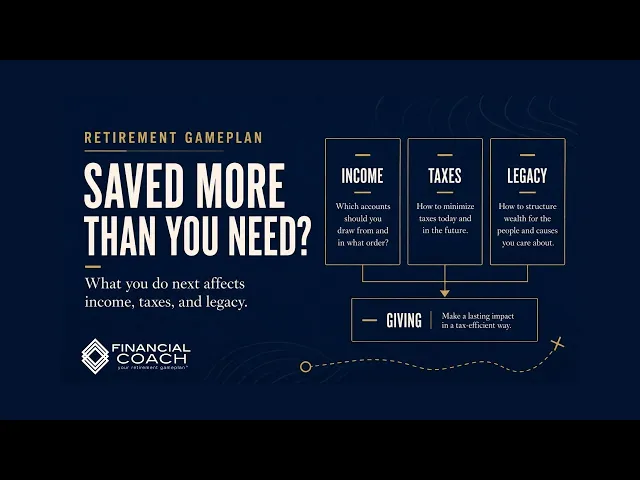
Retirement savings are often discussed in terms of how they are taxed: pre-tax (ex: traditional 401k), after-tax (Roth), or tax-preferred (brokerage–capital gains). We meet many people who don’t have a clear plan for which accounts to pull from first, for either regular income or specific uses.
Understanding this is what we call Asset Location. Simple in theory, but often more difficult in practice. The accounts you draw from today shape the tax bill your family carries for decades.
What This Means for Your Income Today
Once you're pulling income instead of contributing to it, the account you draw from changes what you owe, not just how much you withdraw.
Withdrawals from a traditional 401(k) or IRA count as ordinary income and are taxed accordingly.
Withdrawals from a Roth account are typically tax-free, since that money was already taxed on the way in.
Selling from a brokerage account triggers capital gains tax, usually at a lower rate than ordinary income.
That means the same $10,000 withdrawal can cost very different amounts depending on which account it comes from. A year with a big one-time expense, a wedding, a renovation, a gift to your kids, may be a good year to pull more from a lower-taxed account, or to intentionally fill up a lower tax bracket before it's gone.
There's also a limited window worth knowing about. Early in retirement, before Required Minimum Distributions (RMDs) begin at age 73, there's often an opportunity to convert some pre-tax retirement savings into a Roth IRA, paying the tax on that conversion now, at what may be a lower rate than you'd pay on forced withdrawals later. Once RMDs start, that opportunity closes.
These are principles, but how do you understand your own specific income plan? This is a personal question that requires a personalized answer. If you’re asking this question, see our note at the bottom about our Retirement Gameplan workshop.
What This Means for What You Leave Behind
Money that isn't spent or given away has the opportunity to keep growing. As an illustration:
An additional $2M you don’t need today, growing at a hypothetical 7% average annual rate untouched…
In that scenario, it could become roughly $8M in twenty years.
At that same rate, $8M could become roughly $32M roughly twenty years after that.
If you’re 50 and thinking about what happens when you pass on what’s left 40 years from now, it’s usually worth it to ask.
(These are hypothetical figures based on an assumed growth rate, not a forecast, but they help remind us that invested money with a longer time horizon has more potential than we realize.)
In Pennsylvania, there's a state inheritance tax in addition to anything owed at the federal level.
As an illustration, a $30 million estate passing to direct descendants would owe roughly $1.35 million at the state's current 4.5% rate.
That's a number that deserves our attention now, while there's still time to do something about it. We have clients who explore accelerating their gifting to their kids during their lifetime, structuring their inheritance more strategically, or initiating more charitable activity. A Qualified Charitable Distribution, for example, lets you send money directly from an IRA to a charity tax-free, satisfying part of a required withdrawal while lowering what's taxable.
Ask a client directly: would you rather this money go to your family and the causes you care about, or to the state? Nobody hesitates. The harder part is building a plan that follows through on that answer, well before it becomes urgent.
If you're sitting on more than you expected and aren't sure where the next dollar should come from, we'd be glad to walk through it with you. The value of planning goes far beyond “making sure you have enough.”
–––––
The Retirement Game Plan is the planning process we take every client through. If you'd like to talk through what asset location means for your own plan, a good place to start is a complimentary conversation with one of our coaches. You can schedule one at financialcoachgroup.com/contact.
Not intended as a recommendation or offer of any specific advice or services. All investments carry risk, and past performance does not guarantee future results. For detailed information about our fees, services, and background, please view our regulatory disclosure materials on the SEC Investment Adviser Public Disclosure Website (https://adviserinfo.sec.gov/firm/summary/170478).
Stay Informed, Retire Confidently
Join our community of savvy retirees and get our latest insights first
Investment Advice offered through FC Advisory LLC, a registered investment adviser doing business as “New Wealth Project” and as “Financial Coach”. This content is provided for informational purposes only. Views and opinions expressed are those of the authors and do not necessarily reflect those of FC Advisory, LLC. Information provided is not and should not be interpreted as investment, tax, legal, or other professional advice or recommendation by FC Advisory, LLC or the members of our firm. Always consult the appropriate professional regarding your specific situation before implementing any options presented or inferred. FC Advisory LLC, All rights reserved.
Read more
What To Do After You've Saved More Than You Need For Retirement
The value of planning goes far beyond “making sure you have enough.”
Owen Mulhern
Your First Retired Years, On Diversification & Tax-Smart Giving
We suggest that many of the families we meet use some sort of calculator to model their portfolio over the span of their retirement.
Owen Mulhern

Retirement Paychecks, Market Downturns & Variable Income
For most of your working life, your portfolio had one mission: TO GROW. What changes the moment you retire? THE MISSION.
Owen Mulhern